Monday, September 24, 2018

September 25, 26, 27

Image result for storytelling
http://thecommunitymanager.com/2013/11/14/five-tips-on-using-storytelling-for-community-management/


September 25

1.  Warm-up:  Woosh, Bang, Pow, builds and focuses on energy, commitment and pacing


2. Criterion B reflection

Name of warm-up:  Woosh, Bang, Pow
Purpose: builds and focuses on energy, commitment and pacing
What did you learn?
How can it help you with your acting?

What makes a good story?  p. 124
3.  Read the text
4.  Activity:  What makes a story a story?
     Follow the instructions and complete the activity.  Work in pairs or groups of 3.


September 26
1.  Point of view p. 125
2.  Activity:  Who is telling the story?
     Follow the instructions and complete the activity.  Work in pairs or groups of 3.

September 27

EasyBib (http://www.easybib.com/mla8-format/website-citation)

Criterion A - Research and Assessment

1.  Open a Word document
2.  Type your name at the top left
3.  Title the document   Storytelling   Criterion A - Knowing and Understanding 
4.  Conduct the following research:
  1. What is storytelling?  (write 3-4 sentences using your own words)
  2.  Storytelling in different cultures  (various European, African, North American, Middle American, South American, Asian and Australian cultures. Could include Japan, Russia, Native American, Middle East, etc. 
  • Research storytelling in your culture and give a brief introduction in your own words. (1 paragraph)
  •  Research and choose 1 story from your culture.  Write the name of the story and give a brief summary. Look for myths and legends in your culture. (1 paragraph)
Works Cited page required -  MLA 8 format.

Sunday, September 16, 2018

September 18, 19, 20

Image result for storytelling
http://www.bcgconnect.com/influence-donors-consistent-storytelling/


September 18, 19, 20
1st performance
giving and receiving feedback

Monday, September 10, 2018

September 11, 12, 13

September 11
1.  30 minutes - Follow the link to learn vocabulary about different kinds of stories: https://quizlet.com/151597527/stories-flash-cards/

2.  30 minutes - Research and prepare a story to tell in front of the class. The story should be more than 1 minute but less than 2 minutes.

September 12
1. Irish story telling and Irish story tellers:

Muireann Murphy - https://www.youtube.com/watch?v=fyjrK_rmSPQ


 2.  Discuss
What are some of your favourite stories?  Why do you like them so much?  Can you identify any features of the stories that make them so enjoyable or memorable?

September 13

1.   Warm-up  3 2 1 Acting Studio:  Breathing Relaxation Technique - can find your center, focus and relax for auditions


2.  Research and choose a story that you would like to tell to the class. Guidelines:  Tell a story, 1-2 minutes in length, use your voice and body to add emphasis and make the story more appealing to your audience.

Sunday, September 2, 2018

September 4, 5, 6

https://static.wixstatic.com/media/736b54_7a67687bac4f44dfb60d042f74aa6d8f.png


Welcome to Year 8 Drama!  This term we will be focusing on storytelling.


Image result for Storytelling
http://zinkmarketing.es/en/storytelling-the-art-of-telling-stories/


Welcome to Year 8 Drama!  This term we will be focusing on storytelling.

Who likes stories?  What's your favourite story?

September 4
1.  Let's talk a little about: Year 8 Drama expectations
2.  Let's talk a little about: Arts Process Journal
3. Can you access Managebac?

Warm-up for Drama class

4.  Warm-up - Three Things in Common:  designed to help people get to know each other better (ice breaker)


5.  Write Criterion B  (Developing Skills) reflection (include date of warm-up)
       Name of warm-up
       Purpose of warm-up
       What did you learn?
       How can this help you with your acting?

September 5

1.  Warm-up   Exaggeration Circle -  good warm-up to work on taking something small and heightening it.


2.   Write Criterion B reflection.
       Name of warm-up
       Purpose of warm-up
       What did you learn?
       How can this help you?

3.  Guidelines for Storytellers - Explanation and Discussion

September 6
1. Irish story telling and Irish story tellers:

Muireann Murphy - https://www.youtube.com/watch?v=fyjrK_rmSPQ


 2.  Discuss
What are some of your favourite stories?  Why do you like them so much?  Can you identify any features of the stories that make them so enjoyable or memorable?


 3.  Research and choose a story that you would like to tell to the class. Guidelines:  Tell a story, 1-2 minutes in length, use your voice and body to add emphasis and make the story more appealing to your audience.

September 11
1.  Warm-up -  Breathing Relaxation Technique
Breathing exercise to help you learn to relax before performing


2.  Warm-up reflection

       Name of warm-up
       Purpose of warm-up
       What did you learn?
       How can this help you?

 3.  Prepare your 1st performance.
      Guidelines:  Tell a story, 1-2 minutes in length, use your voice and body to add emphasis and make the story more appealing to your audience.

Tuesday, July 3, 2018

July 3, 4, 5

July 3

1.  Warm-up     Living an emotion . . .


 Notes from video:


* 7 Universal emotions: joy, grief, fear, anger, surprise, love, laughter (people display these emotions in a similar way)

* Emotions scale,

* An emotion brings you on to a scene,

* Live the emotion as you - that's the authentic bit of you that you bring into the story . . .

2.  Two-Person, Two-Minute Improv presentations

July 4 
1.  Warm-up:  Pass the Emotion
Sit in a Drama circle.
We're going to pass a smile around the circle. Start this off by passing a big smile to the person sat to your left, and then encourage it all the way around.
Using the same principle, pass further emotions or feelings.
  • Sad
  • Excited
  • Angry
  • Hungry
  • Scared
  • etc
2.  Warm-up:   
Seven-sentence story structure
Most stories can be boiled down to seven basic sentences. These sentences begin like this:
Once upon a time....
And every day...
Until one day...
And because of that...
Until finally...
And from that day...
It's good to use examples when explaining this, I will use 'Hannah Montana: The Movie' here:
Once upon a time there was a girl who was secretly a pop-star. And every day she was careful not to let anyone know her secret. Until one day she met a boy, and he discovered her double life. And because of that he was angry and felt betrayed. And because of that Hannah felt awful. Until finally she owned up to her double life. And from that day the people from her home have known and accepted her secret, and she and the boy are very happy.
1. Have the students sit in a circle and ask them to come up with one sentence from the story structure each. If you have more than 7 students you can just begin from the first sentence again once you reach the eight student.
2. Once you've done this you can broaden the exercise and take away the 7-sentence restriction, allowing students to tell the story in as many sentences as they like.

3.  Warm-up:   Bus Stop
A classic improvisation game based around the characters you might meet at a bus stop.
  • Develop improvisation skills
  • Develop characterisation
When working on specific acting skills (e.g. making an entrance, creating a fully developed character, knowing how to sit), environments such a bus stop become convenient settings for the chance meeting of characters.

You will choose one of the occupations for your character. Imagine that you are waiting at a bus stop for a bus that will take you into New York City when it starts to rain. In character (according to your occupation) you will interact with other people who come into the scene as they try to stay dry while waiting for the bus.

We will start the scene with one person, adding the others at suitable intervals.
Try to let the scene run a little, before jumping in with their own characters.

July 5 
1) Drama Word Puzzle:  Conventions
2) You can watch (in pairs or 3s) videos associated with our unit on Commedia dell'Arte (Modern Family, Middle, Simpsons, Fawlty Towers, etc.)

HAVE. A GREAT SUMMER!  SEE   YOU  IN  SEPTEMBER!

Monday, June 25, 2018

June 26, 27, 28

June 26
1.  Warm up:  Language
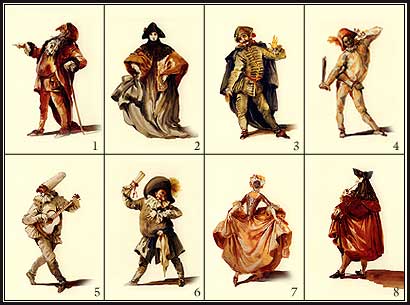
Commedia companies toured outside of Italy, to France and Spain, and so Gromalot evolved, a nonsensical babble speak that carried the truthful emotional intention of a character. This language meant that audiences were able to understand the action on the stage and enabled commedia dell'arte to become an international type of theatre.


2.  Finish stock character worksheet
     http://fliphtml5.com/fhye/uouh/basic

June 27 
Who's Who? Using your stock character worksheet, determine which stock character the characters in this Modern Family episode represent.

Modern Family - episode

June 28


Now it's your turn:  Try it yourself:  Two-Person, Two-Minute Improv

Tuesday, June 19, 2018

June 19, 20, 21

Glossary of words relating to Commedia dell' Arte

Battachio - the wooden bat that Arlecchino used. When it was struck it produced a slap sound.
En travesti - cross dressing of the opposite gender.
Improvisation - creating dialogue and action in the moment.
Innamorati - the young lovers of a scenario.
Intermezzo - short performances of dancing, juggling, skits, songs, etc
Irony - elements of the plot or characterisation that were known to the audience but not the characters on stage.
Lazzi - comedic performances typical to each character that can be inserted in any moment of the play.
Mask - half masks were used by the actors, and were usually made of hardened leather. They were shaped to associate with a certain character and they had exaggerated features such as long noses or wrinkles. Characters were also often referred to by the mask they wore.
Montimbanchi - a person who would get on a stage and try and gather a crowd to watch a show.
Parti ridicole - the ridiculous characters in Commedia dell' Arte
Prima donna - the highest rated innamorata in the production.
Scenario - brief outlines of the plot and the scenes.
Servetta - the confident and witty female servants.
Vecchi - the old men who have control over the lives of the others.
Zanni - the male servants.

June 19 
Research - Take notes. Upload the question and answer to the padlet.
https://padlet.com/rddietrich1/jvusrfhdvl7b

June 20
Football game

June 21
Stock Characters - Worksheet

Thursday, June 14, 2018

June 13


Commedia Dell'Arte


1.  What is comedy? What makes something funny? There are no rules as comedy is subjective.

During this term you will begin your journey to explore comedy as an art form and, hopefully, laugh all along the way.


http://chucklewithsomething.files.wordpress.com/2012/05/comm-del-cast.jpg


2.  What is Commedia dell'Arte?


3.  Let's begin  . . .  Worksheet 1
This worksheet is located above in "Pages".  It is entitled "Worksheet 1".
*You need to include a "Works Cited" page with your final research. 


4.  Before you go, let's take a look at this . . .

Monday, June 11, 2018

June 11, 12, 13


Image result for commentary


June 11, 12 - Criterion D:  Reflective Commentary
For this unit on Storytelling:
Statement of inquiry is:  Personal and cultural expression is expressed through stories.
Global Context is: Personal and cultural expression (artistry, craft, creation, beauty)

1.  Write a paragraph detailing how your research and the warm-ups  influenced your final performance.  Be specific, include details.

2.  Write a strong paragraph on the following topic.  Explain your point of view, include examples to support your ideas. (D strand i)

Considering all the stories you read and told this term, are stories always related to a particular culture  or  are the themes of stories always universal   or  are the themes of stories sometimes universal?

  3. Write a strong paragraph on the following topic.  Explain your point of view, include examples to support your ideas. (D  strand ii)

How do you think your performance and choice of story impacted (or influenced) your classmates?

4. Write a paragraph on the following topic: Explain, include details. (D  strand iii)

How did your feedback help your classmates?  (Write some sentences in general terms, then think about 1 specific student and explain in detail how your feedback could help him/her. Write about how the feedback you received from your classmates, your self-evaluation, and teacher can help you in future performances.)

Tuesday, June 5, 2018

June 5, 6, 7 (Oeiras Holiday)

Image result for a story in 50 words
https://www.pinterest.pt/pin/277745501998682560/?lp=true


June 5, 6
Finish Presentations

June 7 - Oeiras Holiday - no school

Sunday, May 27, 2018

May 29, 30, 31 (national holiday), June 5

Image result for storytelling
http://www.getspokal.com/the-art-of-storytelling-in-content-marketing/

May 29, 30
Story Presentations

May 31 - national holiday

June 5
Story Presentations

Tuesday, May 22, 2018

May 23, 24, 25

Image result for statement of artistic intent
http://www.aidan-hammond.net/pyp-visual-arts/2015/12/13/statements-of-artistic-intent


May 23
3.  a.  Research and choose a story that you will retell in class for you Criterion B Assessment
     b.  What is the moral or theme for that story?
     c.  Why did you choose that story?  What was your inspiration?
     d.  What do you want the Year 8s to learn from this story?

May 24
Statement of Artistic Intention - Criterion C  Assessment  (in-class writing assessment)

Follow the template to write a Statement of Artistic Intention

Paragraph 1:  What are  you doing?  (purpose) This paragraph includes:
-what topic you are studying this term in Drama
-small background about storytelling
-what your task is

Paragraph 2:  Why are you doing this?  (message and inspiration)
-name and brief plotline/storyline of your story
-theme or moral of your story
-what stories did you look at before you chose this one
-why did you choose this story (inspiration)
-what do you want the other Year 8s to learn from your story

Paragraph 3:  How are you going to achieve this (production and performance elements)
-how will you bring your story to life?  (include costume, props, and acting techniques that you will use)
-what challenges do you think you will face when telling your story in front of the class?  (minimum 3)
-How will you overcome these challenges?

May 25 
Performance Rehearsal

Tuesday, May 15, 2018

May 15, 16 17

Image result for aesops fables
May 15
Read and analyze 3 stories. Use the Worksheet to guide you.

Aesop's fables   http://www.read.gov/aesop/

May 16
Presentations

May 17 
1.  Warm-up:  Emotional Fruit Salad - high energy game that works on expressing extreme emotions

Write reflection:
a. name of exercise
b. purpose
c. what you learned doing this activity
d. how this will help you with your acting

2.   Recap


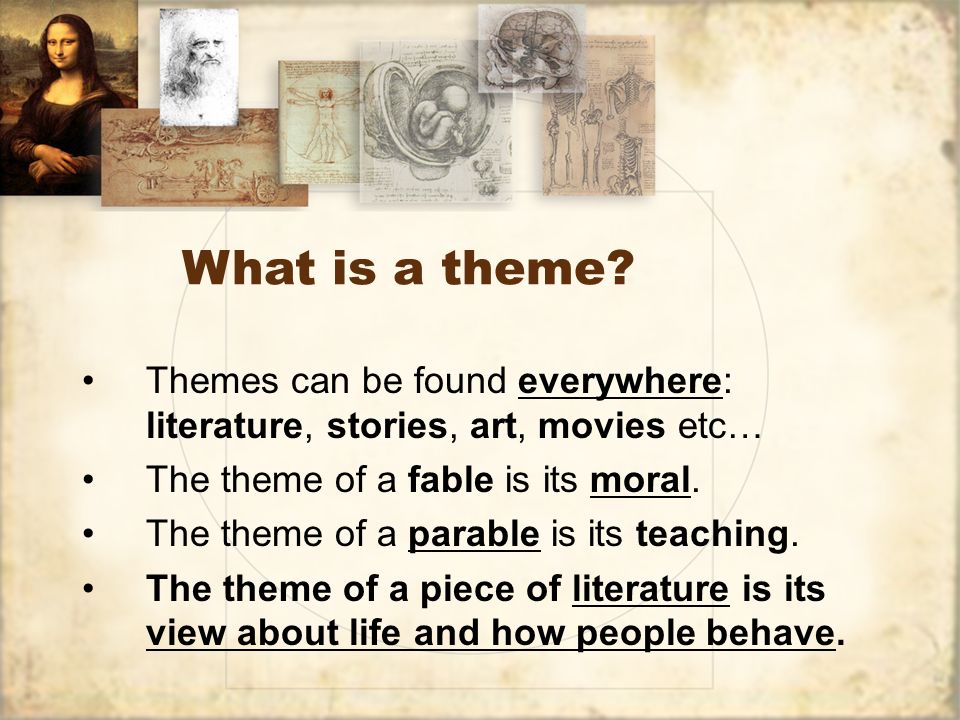
http://slideplayer.com/slide/9713431/31/images/2/What+is+a+theme+Themes+can+be+found+everywhere:+literature,+stories,+art,+movies+etc%E2%80%A6+The+theme+of+a+fable+is+its+moral..jpg

Some of the Most Common Themes in Literature (keywords for more research on this topic:  Common Themes in Literature)
  • Crime Doesn't Pay.
  • Own Worst Enemy.
  • Coming of Age.
  • Overcoming the Odds.
  • Love conquers all.
  • Humanity vs. nature.
  • The individual vs. society.
  • Good vs. evil.
3.  a.  Research and choose a story that you will retell in class for you Criterion B Assessment
     b.  What is the moral or theme for that story?
     c.  Why did you choose that story?  What was your inspiration?

Tuesday, May 8, 2018

May 8, 9, 10

Related image
https://www.goyokids.com/blogs/yoga-ideas-for-kids/the-power-of-storytelling-an-infographic
May8 
Paperwork, printing


May 9

Word association firing line -  great for loosening people up, getting them used to being spontaneous, in the moment and focusing on listening and responding without censoring themselves.


https://i.pinimg.com/736x/24/62/ed/2462ed4be37ae8677840fb27d638e561--companion-gardening-companion-planting-layout-vegetables.jpg


A Legend:  Three Sisters (http://www.mlui.org/userfiles/filemanager/1713/)
 1)  Read
 2) Answers the questions
 3) Discuss

May 10

1.  Fable - What is a fable?  It is a literary genre. It is a short story that teaches a moral lesson.
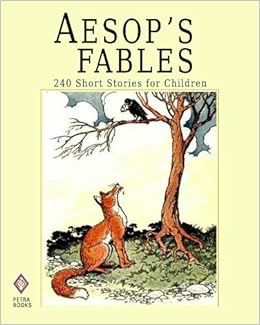
The most famous fables are from Aesop. According to Wikipedia, "Aesop ( c. 620 – 564 BCE) was a Greek fabulist and story teller credited with a number of fables now collectively known as Aesop's Fables. Although his existence remains unclear and no writings by him survive, numerous tales credited to him were gathered across the centuries and in many languages in a storytelling tradition that continues to this day. Many of the tales are characterized by animals and inanimate objects that speak, solve problems, and generally have human characteristics."

2. Let's try one: The tortoise and the  hare, an Aesop Fable
http://diannedelascasas.com/wp-content/uploads/2012/10/Tortoise_Hare.pdf

Aespo's fables can be found here:  http://www.read.gov/aesop/

3. Find a story (research) that you like online and  read it aloud to yourself.  
Evaluate your stories once more for tellability and learnability as they read aloud, as this will be a different experience than reading it in your head and assessing it. Keep in mind the specifics of tellability and learnability. 

4. Read and analyze 3 stories. Use the Worksheet to guide you.

Wednesday, May 2, 2018

May 1, 2, 3


Image result for MYP criterion A Arts 


May 1 - National Holiday, no class


May 2, 3
1.  Open a Word document
2.  Type your name at the top left
3.  Title the document   Storytelling   Criterion A - Knowing and Understanding 

4.  Conduct the following research:
     1.  What is storytelling?  (Write 3-4 sentences using your own words)
  Storytelling in different cultures (various European, African, North American, Middle American, South American, Asian and Australian cultures.  Could include Japan, Russia, Native American, Middle East, etc.)
          2.  Research storytelling in your culture and give a brief introduction in your own words.
          3.  Research and choose 1 story from your culture.  Write the name of the story and give a brief summary. Look for myths and legends in your culture. (1 paragraph)
           4.  Research storytelling in another culture and give a brief introduction in your own words.
           5. Research and choose 1 story from another culture. Write the name of the story and give a brief summary.  Look for myths and legends in that culture. (1 paragraph)
           6. Critically analyze (compare AND contrast) these 2 stories  (How are they the same?  How are they different?  Look at content,  structure,  language, purpose, and anything else you think is notable).  Complete a Venn Diagram:  https://study.com/academy/lesson/what-is-a-venn-diagram-lesson-for-kids.html
           7.  What was the importance of story-telling in history? Explain, include details.
           8.   How have the stories told in the past influenced the present?  Explain, include details.
           9.  How will this research help you prepare your performance?  Explain, include details
Works Cited page required -  MLA 8 format

Remember, you will need a Works Cited page.  The Works Cited page is always the last page of your document.  Here is a website that will help you create the page properly:  Citation Machine -  http://www.citationmachine.net/ 

Tuesday, April 24, 2018

April 24, 25, 26

http://slideplayer.com/slide/9713431/31/images/2/What+is+a+theme+Themes+can+be+found+everywhere:+literature,+stories,+art,+movies+etc%E2%80%A6+The+theme+of+a+fable+is+its+moral..jpg
April 24

Finish work from last week.

3 Ways Acting Exercise - helps with delivery


April 25 - National holiday 


April 26

Dialogue - the words that the actor speaks

3 Ways Acting Exercise - helps with delivery


List of acting emotions for practice:

  • anger
  • anticipation
  • anxiety
  • arrogance
  • embarrassment
  • boredom
  • confidence
  • contentment
  • depression
  • disappointment
  • disgust
  • ecstasy
  • exhaustion
  • fear
  • frustration
  • guilt
  • happiness
  • hope
  • hysteria
  • impatience
  • jealousy
  • loneliness
  • love
  • lovesick
  • lust
  • mischievous
  • passion
  • romance
  • shock
  • shyness
  • suspicion

Acting is so much fun.
Summer is right around the corner.
I want to go home now.
Please.
Would you like to go shopping today?
What's for dinner?
The pencil is mine.
I need a haircut.
My homework is in my locker.
Are you serious?
Look over there.
He's coming back.
She's changed her mind.
That's my friend.
I didn't know that.
Where are you going?


Tuesday, April 10, 2018

April 17, 18, 19

Image result for storytelling
http://thecommunitymanager.com/2013/11/14/five-tips-on-using-storytelling-for-community-management/


April 17
What makes a good story?  p. 124
1.  Read the text
2.  Activity:  What makes a story a story?
     Follow the instructions and complete the activity.  Work in pairs or groups of 3.


April 18
1.  Point of view p. 125
2.  Activity:  Who is telling the story?
     Follow the instructions and complete the activity.  Work in pairs or groups of 3.

April 19

Criterion A - Research and Assessment

1.  Open a Word document
2.  Type your name at the top left
3.  Title the document   Storytelling   Criterion A - Knowing and Understanding 
4.  Conduct the following research:
  1. What is storytelling?  (write 3-4 sentences using your own words)
  2.  Storytelling in different cultures  (various European, African, North American, Middle American, South American, Asian and Australian cultures. Could include Japan, Russia, Native American, Middle East, etc. 
  • Research storytelling in your culture and give a brief introduction in your own words. (1 paragraph)
  •  Research and choose 1 story from your culture.  Write the name of the story and give a brief summary. Look for myths and legends in your culture. (1 paragraph)

Works Cited page required -  MLA 8 format

April 10, 11, 12

Image result for storytelling
http://www.partyfiestar.sg/children-storytelling/


April 10, 11, 12
1st performances and peer feedback

1.  We review the Drama Storytelling rubric
2.  Discuss peer feedback guidelines
3.  Student Presentations

Tuesday, March 20, 2018

March 20, 21, 22


March 20

1.  Warm-up   Exaggeration Circle -  good warm-up to work on taking something small and heightening it.


2.   Write Criterion B reflection.
       Name of warm-up
       Purpose of warm-up
       What did you learn?
       How can this help you?

3.  Guidelines for Storytellers - Explanation and Discussion


March 21 1. Irish story telling and Irish story tellers:
  
Muireann Murphy - https://www.youtube.com/watch?v=fyjrK_rmSPQ


 2.  Discuss
What are some of your favourite stories?  Why do you like them so much?  Can you identify any features of the stories that make them so enjoyable or memorable?


 3.  Research and choose a story that you would like to tell to the class

March 22
1.  Warm-up -  Breathing Relaxation Technique
Breathing exercise to help you learn to relax before performing


2.  Warm-up reflection

       Name of warm-up
       Purpose of warm-up
       What did you learn?
       How can this help you?

 3.  Prepare your performance

Tuesday, March 13, 2018

March 13, 14, 15

Image result for Storytelling
http://zinkmarketing.es/en/storytelling-the-art-of-telling-stories/

Welcome to Year 8 Drama!  This term we will be focusing on storytelling.

March 13, 14
Talent Show Rehearsal

March 15
1.  Let's talk a little about Year 8 Drama expectations
2.  Let's talk a little about your Arts Process Journal
3. Can you access Managebac?

Warm-up for Drama class

4.  Warm-up - Three Things in Common:  designed to help people get to know each other better (ice breaker)


5.  Write Criterion B  (Developing Skills) reflection (include date of warm-up)
       Name of warm-up
       Purpose of warm-up
       What did you learn?
       How can this help you with your acting?

Tuesday, March 6, 2018

March 6, 7, 8

Image result for greek drama
http://slideplayer.com/slide/3784682/


March 6, 7

Introduction to Greek Drama 
    What is Greek Drama?  Have you ever heard of Greek Drama?  Let's discover . . .

https://www.ket.org/education/resources/introduction-greek-drama/

1.   Read the text, listen to the podcast and take the test.
https://www.ducksters.com/history/ancient_greece/drama_and_theatre.php

2.  Research Ancient Greece.  Read the text and take the test.
http://www.ducksters.com/history/ancient_greece/greek_city_state.php

3.  Research Women in Ancient Greece.  Read the text and take the test. 
http://www.ducksters.com/history/ancient_greece/womens_roles.php 

March 8
1. Ancient Greeks: Arts and theatre
http://www.bbc.co.uk/schools/primaryhistory/ancient_greeks/arts_and_theatre/

2.  Theatre of Ancient Greece
https://kids.kiddle.co/Theatre_of_ancient_Greece

Wednesday, February 28, 2018

February 27, 28, March 1

February 27
Final Presentations

February 28, March 1

Criterion D - Responding

For this unit on Storytelling:
Statement of inquiry is:  Personal and cultural expression is expressed through stories.
Global Context is: Personal and cultural expression (artistry, craft, creation, beauty)

1. Write a strong paragraph on the following topic.  Explain your point of view, include examples to support your ideas. (D strand i)

Considering all the stories you read and told this term, are stories always related to a particular culture  or  are the themes of stories always universal   or  are the themes of stories sometimes universal?

 2. Write a strong paragraph on the following topic.  Explain your point of view, include examples to support your ideas. (D  strand ii)

How do you think your performance and choice of story impacted your classmates?

3. Write a paragraph on the following topic.  Expain, include details. (D  strand iii)


How did your feedback help your classmates?  (Write some sentences in general terms, then think about 1 specific student and explain in detail how your feedback could help him/her.

Homework:  #1, 2.    Due March 1
 
4.  Write a paragraph on the following topic.  Explain, include details.  (D  strand iii)

Evaluate your own performance.  (Using the feedback you received from your peers, evaluate your strengths and weaknesses.   How would you improve?  What would you do differently next time?)

Tuesday, February 20, 2018

February 20, 21, 22

Image result for citation machine


 February 20

2 websites that can help you make a Works Cited page are:
     1.  http://citatationmachine.net
     2.  http://easybib.com


February 21
Practice Final Performance


February 22
Final Performance Presentations

Wednesday, February 7, 2018

February 6, 7, 8

 
http://slideplayer.com/slide/9713431/31/images/2/What+is+a+theme+Themes+can+be+found+everywhere:+literature,+stories,+art,+movies+etc%E2%80%A6+The+theme+of+a+fable+is+its+moral..jpg

Some of the Most Common Themes in Literature (keywords for more research on this topic:  Common Themes in Literature)
  • Crime Doesn't Pay.
  • Own Worst Enemy.
  • Coming of Age.
  • Overcoming the Odds.
  • Love conquers all.
  • Humanity vs. nature.
  • The individual vs. society.
  • Good vs. evil.

February 6
The  week in review

February 7
1.  Research and choose a story that you will retell in class for you Criterion B Assessment
2.  What is the moral or theme for that story?
3.  Why did you choose that story?  What was your inspiration?

February 8

Statement of Artistic Intent:  Criterion C

Tuesday, January 23, 2018

January 30, 31, February 1

https://cms.springbranchisd.com/portals/29/Staff/Middle%20School/wegscheidc/arts%20wheel.jpg
Criterion A Knowing and Understanding Assessment

1) What is storytelling?   (write 3-4 sentences)

2) Storytelling in 2 different cultures   (various European, African, North American, Middle American, South American, Asian and Australian cultures.  Could include Japan, Russia, Native American, Middle East etc.)
        Choose 2 different cultures and give a brief introduction to each.

3)  Research and choose 1 story from each of the 2 cultures above.  Give a brief summary of each one.
            
4) Critically analyze (compare AND contrast) these 2 stories  (How are they the same?  How are they different?  Look at content,  structure,  language, purpose, and anything else you think is notable).  Complete a Venn Diagram.

5.  What was the importance of story-telling in history? Explain, include details.

6.   How have the stories told in the past influenced the present?  Explain, include details.

Remember, you will need a Works Cited page.  The Works Cited page is always the last page of your document.  Here is a website that will help you create the page properly:  Citation Machine -  http://www.citationmachine.net/ 

Print.  Due at the end of class on February 1.

January 23, 24, 25

https://i.pinimg.com/736x/24/62/ed/2462ed4be37ae8677840fb27d638e561--companion-gardening-companion-planting-layout-vegetables.jpg
 January 23, 24

1.  Read the legendThe Three Sisters
2.  Highlight each word that you don't know.  Create a "vocabulary list"of these words. Find a definition for each work and include it on your vocabulary list.  OR   Find the definition and write it near the word on the text.
3.  Class discussion  (take notes)
4.  Complete the worksheet

January 25
1. How to conduct research  - Key word search
2. Works Cited: Here is a website that will help you create the page properly:  Citation Machine -  http://www.citationmachine.net/

Tuesday, January 16, 2018

January 16, 17, 18

http://d28hgpri8am2if.cloudfront.net/book_images/onix/interior_spreads/9781481435185/the-storyteller-9781481435185.in01.jpg
January 16, 17
1.  3 students tell their story.

1. Guidelines for Storytellers (handout 1)

    Let's read the handout together for understanding.  Please put this handout into your process journal :)

2. Now, it's your turn:
http://read.gov/aesop/001.html

Read and analyze 3 stories. Use the Worksheet to guide you.

January 18


1.  Warm-up   3 Ways Acting Exercise  (helps with delivery)


Tuesday, January 9, 2018

January 9, 10, 11

https://img.wonderhowto.com/img/52/78/63536283888612/0/10-surefire-ways-spot-liar-and-tell-better-lies-yourself.1280x600.jpg
 January 9, 10

Learning Objective:  Students will be able to identify the basics of storytelling after class discussion and shall demonstrate them through the improv game “Liar.”


1.  Storytelling elements:
https://ind5.ccio.co/C7/5/w8/9cb5f1ecee949d1f4ec6d193e0965e5e.jpg
 2.  “Liar.” This game is played by having one student stand in front of the class and tell a story.

Before the teller begins, ask the rest of the class for a setting and a conflict. The student telling the story must tie these elements into the story. At any point, the audience may yell “liar!” at the teller. When this happens, the teller must change what he or she just said. For example:
Teller: I walked into the bookstore…
Audience: LIAR!
Teller: I army crawled into the bookstore…
The audience is capable of yelling “liar!” at any point and multiple times at once, but stress that they must allow the storyteller to tell the story. It may be best to have the teacher be the only one allowed to yell “liar!” until it feels that the class understands the rhythm. As different stories are told, be sure to ask what good elements are being used. The teller should never say “I didn’t do _____, I did ______ instead”, because it breaks the flow. Simply change what happened.


3.  Fable - What is a fable?  It is a literary genre. It is a short story that teaches a moral lesson.
The most famous fables are from Aesop. According to Wikipedia, "Aesop ( c. 620 – 564 BCE) was a Greek fabulist and story teller credited with a number of fables now collectively known as Aesop's Fables. Although his existence remains unclear and no writings by him survive, numerous tales credited to him were gathered across the centuries and in many languages in a storytelling tradition that continues to this day. Many of the tales are characterized by animals and inanimate objects that speak, solve problems, and generally have human characteristics."

Let's try one: The tortoise and the  hare, an Aesop Fable
http://diannedelascasas.com/wp-content/uploads/2012/10/Tortoise_Hare.pdf


Find a story that you like and  read it aloud to yourself.  
Evaluate your stories once more for tellability and learnability as they read aloud, as this will be a different experience than reading it in your head and assessing it. Ask them to keep in mind the specifics of tellability and learnability. 


Now, it's your turn:
http://read.gov/aesop/001.html